What Does AI Founder Mode Mean for Business?
AI Founder Mode means the leader moves closer to the work, not further away, because AI has removed the layers in between.
AI Founder Mode is how you lead when AI can do much of the work.
You build the Company Brain: the living record of what your business knows, values and decides. Every person and every AI agent works from it.
You stay close to the work through that brain. You decide what AI handles, who owns each piece, and where human judgement must stay.
You start hands-on and give ground slowly, as trust is earned. Success is measured by what customers feel, not by how much AI you use.
Open with your own story: what you changed in your own business when you went AI-native, which decisions you kept, which you handed to AI Employees, and what happened. Include any numbers you are happy to share.
On a Monday morning in a typical small business, sales might be using AI to clean up proposals, support might be trialling an inbox assistant, marketing might be drafting content faster, and operations might be testing automations in the background. Nothing about that sounds irresponsible. In fact, it probably sounds sensible.
The problem arrives later, when the founder or business leader cannot answer three basic questions: what changed for the customer, which workflow actually improved, and who owns the next decision?
That, for me, is what founder mode means in the age of AI.
01What is AI Founder Mode?
AI Founder Mode means business leaders stay close to the decisions that shape AI adoption: which workflows matter, who owns them, where human judgment is required, what risks are acceptable, and how success will be measured.
It is not micromanagement. It is leadership responsibility in a period where AI is changing how work gets done.
It does not mean doing everything personally. It does not mean becoming a bottleneck. It does not mean wandering around the business interfering in every decision. It means staying close enough to the work to understand where AI should matter, which workflows deserve priority, where human judgment still matters, and how success will be judged.
02Where the idea comes from
The phrase “founder mode” became popular after Paul Graham wrote about the difference between founder mode and manager mode. His basic point was that the standard advice given to founders as companies scale is often to hire good people, delegate to them, and stay out of the details. Graham argued that this can be broken advice for founders, because some of the most important work of leadership requires staying closer to the company than conventional management theory allows.
Brian Chesky’s story at Airbnb is helpful here, and his story was the spark for Graham’s essay. During COVID Chesky effectively took back direct operating control of Airbnb having previously followed the advice to “hire good people and give them room to do their jobs.” Graham points out that ‘he followed this advice and the results were disastrous.’ On 5th May 2020, Airbnb announced that global travel had come to a standstill, that revenue was expected to fall sharply, and that nearly 1,900 of its 7,500 employees would leave the company. Airbnb also paused Transportation and Airbnb Studios, scaled back Hotels and Lux, and refocused around its core hosts, homes, experiences, belonging and human connection.
I say that with some affection and a little scar tissue. I once went up against Airbnb when it was first being born, and I obviously lost. So I watch Chesky with interest. Not as a fanboy, but as someone who knows how powerful clarity, timing and execution can be when they come together. I am cheering him on because I think the next phase will be fascinating.
Jack Dorsey has been making a similar, and in some ways more radical, argument at Block. In early 2026, Block announced that it was cutting more than 4,000 employees, with Dorsey explicitly linking the restructuring to what AI now makes possible. The direction of travel appears to be a smaller, faster organisation built around new forms of AI-enabled coordination. (AP News)
That is a hard message, and I do not think we should skate over the human cost of it. Thousands of people losing their jobs is not a neat management theory. These are real people, real families, real consequences.
That does not mean every business should copy Airbnb or Block. Most small businesses should not. You are not Airbnb. You are not Block. You do not need a grand theory of the future corporation before making a useful decision this week. But you do need to pay attention to the pattern. AI does not just make individuals faster. It changes how information moves, how decisions are made, how work is coordinated, and how quickly weak operating habits become visible.
Recently I watched Y Combinator partner Diana Hu unpack the idea of a closed loop, and it helped crystallise why AI Founder Mode is not just about using better tools. It is about changing the operating system of the company itself.
A closed loop is simple to describe: the company captures what happens, feeds it back and improves the next cycle. When that runs continuously, the business learns as it works.
For me, continuous looping is the technical expression of AI Founder Mode. It turns the company from a hierarchy of people passing work around into a live system that can sense, act, learn and improve. Execution compounds with every loop.
The goal is not simply for the founder to do more. It is for reality to reach the founder faster.
03Where the Company Brain fits
In the old founder mode, Chesky held around 35 hours of meetings a week, because meetings were the only way to get the information he needed.
A Company Brain replaces much of that. It is the living record of how the business works:
- what it knows
- its customers
- its rules
- its past decisions
- what good looks like
AI and people both work from it. The leader shapes it directly, instead of hearing about things through layers of managers.
It also fills the three gaps I wrote about in “What Claude Alone Won’t Give You”: context, judgement and accountability. A general AI tool knows a lot about the world and very little about your business. The Company Brain is where your business teaches it.
04Manager mode versus AI Founder Mode
The difference is not philosophical. It is operational.
| Manager mode for AI | AI Founder Mode |
|---|---|
| Treat AI as an innovation project | Treat AI as an operating model shift |
| Start with tools | Start with bottlenecks, customer friction and decision latency |
| Measure activity and usage | Measure cycle time, decision quality and duplicate work removed |
| Add AI to existing workflows | Redesign workflows around continuous loops |
| Rely on managers for status updates | Build systems that make the company queryable in real time |
| Accept context living in meetings, Slack, docs and people’s heads | Turn work into machine-readable artifacts that agents can reason over |
| Create generic AI guidance | Set workflow standards, review points and guardrails |
| Run scattered experiments | Prioritise a few high-value use cases that change how work gets done |
| Use AI to produce more outputs | Use AI to improve the next cycle of action |
| Preserve the pyramid and make it more efficient | Flatten parts of the organisation around an intelligence layer |
| Reward coordination and reporting | Reward ownership, judgment and proximity to the work |
| Talk about urgency | Convert urgency into owners, deadlines, loops and operating rules |
The key shift is this: not, “Are people using AI?” but, “Is AI changing how the company senses, decides, acts and learns?” That is the founder mode distinction.
AI exposes weak operating habits faster than most change efforts because it is easy to start and hard to integrate. A team can open an account, test a tool, or automate a step in an afternoon. That low barrier is useful. It is also dangerous.
Goldman Sachs 10,000 Small Businesses Voices found that 76% of small businesses report using AI, but only 14% say it is fully integrated into core operations. That does not prove weak leadership is the only cause. But it does show the core problem. In small businesses, AI use is running ahead of AI integration. Broader market data points in the same direction. Nasdaq’s 2026 Outlook Survey found that only 5% of leaders described their organisations as AI-native, while 71% categorised themselves as AI “newbies” or “explorers”. (Nasdaq)
Tool usage can feel like momentum even when no core process has improved.
05Five signs your AI effort is drifting
If you want a blunt diagnostic, start here.
If AI activity is rising but execution still feels scattered, I would start by looking for the gap between enthusiasm and execution. Usually, the problem is not that people are unwilling to try. It is that nobody has clearly decided which business problem AI is meant to solve, who owns the workflow, and what better actually looks like.
06The PIE check: your first move
This is the tool I come back to most. Three questions, asked before your next AI meeting, show whether leadership is keeping pace with the tooling.
- P · Personal.What do you, as the leader, need to understand firsthand rather than through a second-hand update?
- I · Internal.Which workflow needs one clear owner, one clear standard and one clear review rhythm?
- E · External.Where will the customer notice the difference first, for better or worse?
If those answers are fuzzy, the business is probably moving faster in tooling than in leadership. Your first move this week is simple: choose one workflow, one owner and one review date. That will teach you more than another month of vague experimentation.
For example, a small professional services firm might start with proposal turnaround. The current process takes three days, depends on one senior person, and often creates delays for prospective clients. A useful AI implementation would not simply “help people write proposals faster.” It would create a clearer workflow: intake notes captured in a standard format, a first draft generated from approved language, human review for pricing and judgment, and a final quality check before it goes to the client. The business outcome is not “we used AI.” It is that proposal turnaround moves from three days to the same day, without lowering quality or increasing risk. And before long the pricing guardrails enable the proposal to work end to end, and the final review is quick.
Run the PIE check on that firm and the first moves become obvious:
- Personal. The founder reads the last five proposals and one AI draft side by side, rather than relying on a summary.
- Internal. One person owns the proposal workflow, with one template, one quality standard and a review every fortnight.
- External. The founder checks what clients notice: how quickly a first draft arrives and whether more proposals are won.
07Putting it into practice
Founder mode does not mean personally controlling everything. It means staying close to the decisions that define how the business actually runs.
Here is the checklist I use.
This is founder mode in practice. Not ego. Not chaos. Responsibility.
Practical guardrails
There is a bad version of founder mode that confuses urgency with impulse. Avoid it.
The goal is not to create a policy that sounds impressive but never shapes behaviour. The goal is to give people simple rules they can apply when real work is moving quickly.
Responsible AI should be practical, not theatrical.
Direct engagement is not the opposite of governance. In a small business, it is often how governance becomes real. How does the founder ensure speed does not outrun judgment?
08What changes when leaders stay close
1. Customer outcomes improve first
When leaders stay close to where AI touches the customer, they make better judgment calls. Where will customers value speed? Where will they notice sloppiness? Where should a human still step in?
I felt this sharply today. I found myself stuck with a chatbot from a company I have been a customer of for 15 years. Having experienced brilliantly effective chatbots where the business owners have clearly spent time designing the experience properly, this one made my opinion of the company dip.
It was inefficient. It was taking up more time than it saved. And the more it struggled to help, the more aware I became of how precious that time was.
Why am I being asked to invest time I would rather spend with my children?
That is the customer test. If your chatbot genuinely helps, brilliant. If it cannot, the best thing it can do is move me quickly and gracefully to a human. Good automation should respect the customer’s time. It should make the experience feel easier, not leave people doing the work the system was supposed to reduce.
2. Processes become clearer
Weak execution creates tool sprawl. One team uses one assistant. Another builds a workaround. Another writes its own prompts.
Direct engagement cuts through that. The founder does not need to own every step, but they do need to force a few hard decisions: which workflows matter, who owns them, what standards apply, and how results are reviewed. That is how experimentation becomes an operating discipline.
3. Innovation becomes cumulative
Many businesses already have enough curiosity. What they lack is a learning loop. A founder-led approach compounds learning. One useful workflow gets tested, improved, documented and scaled. One customer lesson shapes the next decision. One success creates a clearer model for the team.
Without that loop, innovation stays scattered. With it, the business gets better at knowing what is worth keeping.
09When founder mode is the wrong answer
The danger, of course, is obvious. Founder mode can be misused. It can become an excuse for ego, control, impulse or micromanagement. But the useful version is not that. The useful version is presence: a leader staying close to the few decisions that define how the business actually works.
If you are already the bottleneck, staying closer to everything makes it worse. Pick the few decisions that matter and hand the rest to named owners.
In regulated work, such as finance, health or legal services, the rules decide who signs off, not the founder’s instinct. Founder mode works inside those controls, not around them.
And past a certain size, no single leader can stay close to every workflow. The job then becomes building the Company Brain and the owners, so that closeness scales without you.
One AI ownership mistake you made. Suggested draft to adapt or delete (not a real event): “Early on, I let AI draft client follow-ups without naming who owned the standard. Each one sounded slightly different, a few went out with the wrong details, and nobody spotted it for weeks because everyone assumed someone else was checking. The fix was simple: one owner, one template and a weekly review.”
Through all of this chaos, you are already a symphony, a symphony, and even in the madness, there is peace.
10Key takeaways
Most businesses no longer need convincing that AI exists. The harder question is whether someone senior is close enough to the work to turn experimentation into a better way of operating.
That is the real Founder Mode question. Not: are we trying AI? But: who owns the changes AI is making to our decisions, workflows and customer experience?
If the answer is vague, that is the risk. Not slow tooling. Slow responsibility.
This reflection draws on Paul Graham’s “Founder Mode” essay for the founder mode and manager mode distinction; Airbnb’s May 2020 reset and later comments from Brian Chesky; Block’s restructuring and “hierarchy to intelligence” framing; Goldman Sachs 10,000 Small Businesses Voices data on SME AI adoption; Nasdaq’s 2026 Outlook Survey; WRITER’s AI adoption research; and Gary Vaynerchuk’s comments on AI, workforce capability and people-centred adoption.
Written by Caleb, co-author of Futureproof.
Questions people ask
What does AI Founder Mode mean?
AI Founder Mode is how you lead when AI can do much of the work. Leaders stay close to the few decisions that shape AI adoption: which workflows matter, who owns them, where human judgement must stay and how success is measured.
What is a Company Brain?
A Company Brain is the living record of how a business works: what it knows, its customers, its rules, its past decisions and what good looks like. People and AI both work from it, so leaders can shape the work directly instead of waiting for updates through layers of managers.
Where should a small business start with AI?
Start with one to three bottlenecks, not twenty tools. Look for places where time, quality, cost or customer frustration is already obvious.
Take it further
Your learning log · 0 of 10 points read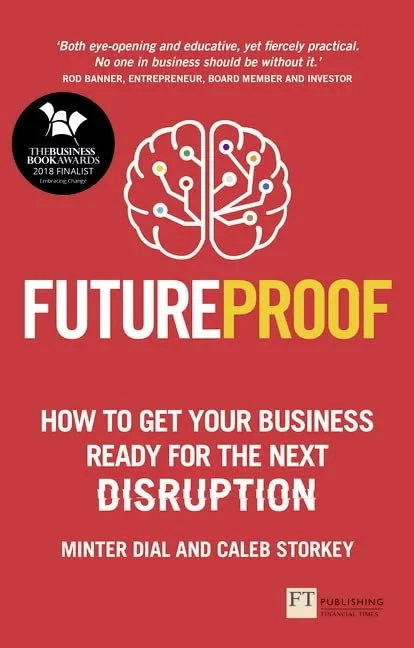
“There are usually two responses to hearing about ‘disruption’: panic or denial. Futureproof gets beyond that...”